Selecting the correct bulk material handling equipment is a high-stakes engineering decision. It directly impacts facility throughput, maintenance overhead, and product integrity. Plant managers face continuous pressure to optimize production lines, and choosing the wrong transport mechanism often leads to chronic bottlenecks. Misaligning the conveyor technology with material characteristics—such as moisture content, bulk density, abrasiveness, fragility, or particle size—frequently results in excessive energy consumption, cross-contamination, or catastrophic equipment wear.
Resolving the pneumatic conveying vs screw conveyor debate requires moving beyond basic definitions. You must conduct an objective, evidence-based evaluation of material behavior, routing geometry, containment requirements, and process visibility. Facility constraints dictate what is physically possible, but the material state ultimately governs what is mechanically viable. By analyzing these core dimensions, you can engineer a transport solution that maximizes uptime and preserves product quality.
Material State is the Primary Filter: Screw conveyors are the industry standard for wet sludge, heavy, sticky, irregularly shaped, or highly abrasive materials, whereas pneumatic systems excel with dry powders, granules, and materials requiring strict sanitary isolation.
Routing Geometry Dictates Feasibility: Pneumatic conveying offers unparalleled flexibility for complex, multi-directional, and long-distance routing; screw conveyors are generally restricted to short-to-medium distance, straight-line transfers.
Containment vs. Visibility: Pneumatic systems provide fully enclosed, dust-free environments ideal for hazardous or easily contaminated products. Screw conveyors offer higher volumetric throughput for dense materials at a lower energy footprint, while allowing for easier visual inspection of the material flow.
Table of Contents
Understanding the fundamental mechanics of each system is the first step in equipment selection. Both technologies move bulk solids, but they rely on entirely different physical principles. One uses fluid dynamics, while the other relies on brute mechanical force. You cannot substitute one for the other without completely redesigning the process flow.
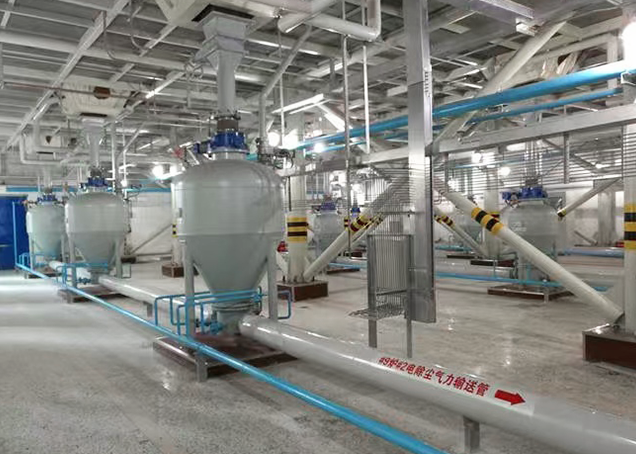
Pneumatic conveying utilizes pressurized air or gas to propel bulk materials through fully enclosed pipelines. This method relies on creating a pressure differential along the pipeline. Depending on the system design, it operates using either positive pressure to push material from a single source to multiple destinations, or vacuum pressure to pull material from multiple sources to a single destination. The air acts as the carrier medium, suspending or pushing the particles from the feed point to the discharge point.
Engineers categorize these systems into two distinct phase variations based on air velocity and material concentration. Dilute phase operates at high velocity and low pressure. Particles remain fully suspended in the air stream, moving rapidly through the pipe. It is highly effective for light, non-abrasive powders like flour or plastic pellets, but the high speeds can cause severe degradation in fragile materials. Dense phase operates at low velocity and high pressure. Material moves in distinct slugs or a continuous moving bed along the bottom of the pipe. This phase uses significantly less air, making it gentler on fragile particles and highly effective for heavier or slightly abrasive materials like coffee beans or blended granular products.
The core components of a pneumatic architecture require precise integration. Positive displacement blowers or air compressors generate the necessary airflow. Rotary airlock valves introduce material into the pressurized line without losing system pressure; the machined tolerances on these valves are critical to prevent air blowby. Conveying lines route the material, utilizing specialized sweep elbows to minimize friction. Finally, filter receivers and dust collection systems separate the conveying air from the product at the discharge point, ensuring clean air exhausts into the facility.
The screw conveyor is a highly robust subset of mechanical conveying. It utilizes a rotating helical screw blade, known as flighting, positioned within a stationary U-trough or tubular housing. As the drive motor turns the shaft, the flighting acts as a continuous wedge, pushing the bulk material forward mechanically along the trough bottom. It relies on Archimedes' principle, generating immense torque to force material through the housing.
Design variations adapt to specific material challenges. Shafted screws feature a central solid pipe supporting the flighting. They are the standard choice for dry, granular, and free-flowing materials. Shaftless screws eliminate the central pipe entirely, using a heavy-duty, high-tensile spiral resting directly on a trough liner. This design prevents wet, sticky, or stringy materials from wrapping around the shaft and causing blockages, making it the default choice for municipal sludge or industrial filter cake.
Core components include the drive motor and gear reducer, which provide the necessary torque to overcome material resistance. The screw flighting does the actual moving, and its pitch can be modified—standard pitch for horizontal runs, short pitch for inclines, or variable pitch for feeder applications. The trough or tube contains the material. Hanger bearings support the shaft in longer runs to prevent deflection, while discharge chutes direct the exiting product into downstream equipment.
Comparing these technologies requires analyzing specific application variables. No single system works for every bulk solid. You must evaluate material traits, facility layout, hygiene standards, and throughput requirements to make an informed engineering decision.
The physical state of your bulk material dictates the conveying method more than any other factor. Ignoring material properties leads to immediate operational failure, plugged lines, and damaged equipment.
Moisture and viscosity play critical roles in system selection. Screw conveyors handle wet sludge, semi-wet cake, and sticky materials effectively. Shaftless designs excel here by preventing material buildup and allowing cohesive materials to slide along the UHMW trough liners. Pneumatic systems fail rapidly with high-moisture materials. Wet powders adhere to the internal pipeline walls, eventually choking the airflow, increasing system backpressure, and causing severe blockages that require manual cleanout.
Bulk density, abrasiveness, and particle irregularity also divide the two technologies. Screw conveyors can move dense metal chunks, irregularly shaped e-waste like shredded circuit boards, and highly abrasive aggregates like foundry sand. They rely on low-speed mechanical pushing, which handles heavy loads easily. When handling abrasives, engineers simply specify heavier flighting and keep the trough loading volume low (around 15%) to minimize wear. Pneumatic systems face severe pipeline wear from abrasives unless using specialized dense-phase configurations. High-velocity dilute phase systems will quickly erode standard pipe elbows when handling abrasive grit, blowing holes through the metal in a matter of weeks. Consequently, air-driven systems are generally limited to uniform powders, granules, or small pellets.
Friability, or particle fragility, requires careful consideration. Mechanical screws can crush or degrade fragile materials as particles get pinched in the clearance space between the rotating flighting and the stationary trough wall. Pneumatic systems, specifically dense phase, offer gentler handling. By moving material slowly in solid slugs, dense phase conveying preserves particle integrity, prevents smearing of fat-coated products, and minimizes dust generation.
Plant geometry often forces the selection of one system over the other. Space constraints, existing structural steel, and transfer distances dictate the physical infrastructure required to move product from point A to point B.
Distance capabilities differ vastly. Screw conveyors are optimal for short-to-medium transfers. A single unit typically runs under 100 to 150 feet before the torque requirements on the center shaft become too extreme, risking shaft failure. Pushing material mechanically over long distances requires immense torque and massive drive units. To go further, you must cascade multiple conveyors, dropping material from one into the next. Pneumatic systems can transport materials over hundreds or thousands of feet using a single blower package and a continuous pipeline.
Elevation and geometry present another major divergence. Pneumatic lines can navigate tight corners, vertical lifts through multiple floors, and complex facility layouts with a minimal footprint. A simple sweep elbow changes the direction of flow, allowing the pipe to route around existing tanks and columns. Screw conveyors require straight-line paths. Any change in direction necessitates multiple cascading units, separate drive motors, and transition chutes. This takes up significant floor space, increases mechanical complexity, and adds multiple potential failure points to the process line.
Regulatory standards in food, pharmaceutical, and chemical processing demand strict environmental control. Material containment is non-negotiable in these sectors to protect both the product and the plant personnel.
Sanitary requirements heavily favor air-driven transport. Pneumatic conveying offers a completely sealed environment. This makes it the superior choice for applications requiring zero cross-contamination. Clean-in-place (CIP) capabilities are easier to integrate into smooth stainless steel pipelines. Washdown fluids can be pumped through the exact same lines used for the product. Screw conveyors have inherent crevices, intermediate hanger bearings, and end seals that harbor bacteria and require intensive manual teardown for proper sanitation.
Handling hazardous materials requires preventing environmental exposure. Vacuum pneumatic systems inherently prevent toxic dust from escaping into the facility. If a leak occurs in a vacuum line or at a pipe joint, ambient air draws inward, keeping the hazardous product contained within the system. Screw conveyors, even when fitted with bolted covers and heavy-duty gaskets, pose higher risks of dust generation. Transfer points, where material drops from one conveyor to another, are notorious for releasing fugitive dust into the plant environment, requiring secondary dust collection hoods.
Operators need to monitor material flow and access equipment for clearing jams, performing inspections, or conducting routine maintenance. The two systems offer contrasting levels of visibility.
Visual inspection is straightforward with mechanical systems. Screw conveyors allow for relatively easy visual inspection and physical access. Operators can look through grated covers, open hinged lids, or utilize drop-bottom troughs to see exactly how the material is behaving. This accessibility is highly beneficial for high-capacity, visible transport monitoring and quick cleanouts during product changeovers.
Enclosed monitoring presents a challenge for air-driven systems. Pneumatic conveying pipelines operate as closed, opaque systems. You cannot see the material moving inside the steel or aluminum pipes. Monitoring flow and detecting blockages requires specialized pressure sensors, sight glasses installed at specific intervals, or acoustic monitors. Troubleshooting a plugged line often requires systematic pressure testing along the route to locate the exact point of the blockage.
Production demands fluctuate. Facilities must scale their operations efficiently without replacing entire infrastructure systems or shutting down the plant for extended periods.
Volumetric efficiency highlights the strength of mechanical transport. Screw conveyors provide consistent, high-capacity transfer for heavy bulk materials. They move massive volumes of dense product at low rotational speeds. Because they rely on direct mechanical drive, they handle surge loads effectively without stalling, provided the motor has sufficient horsepower.
System scaling favors pipeline infrastructure. Expanding a pneumatic system often requires only extending the pipeline routing and upgrading the blower package to handle the increased pressure drop. The physical footprint of the pipe remains small. Expanding a screw conveyor system requires purchasing and installing entirely new mechanical units, building new structural steel supports, and allocating significant floor space to accommodate the rigid equipment.
Bulk Material Suitability Matrix
Material Characteristic | Pneumatic System Suitability | Mechanical Screw Suitability |
|---|---|---|
Dry, Free-Flowing Powders | Excellent (Dilute or Dense Phase) | Good (Requires tight clearances) |
Wet, Sticky Sludge | Poor (Will plug lines immediately) | Excellent (Using shaftless design) |
Highly Abrasive Grit | Moderate (Requires dense phase & ceramic elbows) | Good (Requires low trough loading & AR steel) |
Fragile Particles | Good (Dense phase only) | Poor (Pinches and crushes material) |
Large, Irregular Chunks | Poor (Requires massive pipe diameters) | Excellent (Easily pushes large solids) |
Every bulk handling system carries inherent operational risks. Identifying these failure points during the design phase allows engineers to implement effective mitigation strategies before the equipment hits the plant floor.
Air-driven systems rely on precise fluid dynamics. Disrupting this balance causes immediate conveying failures, bringing the entire process line to a halt.
Line plugging is the most common failure mode. It is typically caused by incorrect air-to-material ratios, unexpected moisture entering the line, or blower degradation. When the air velocity drops below the material's saltation point, particles fall out of suspension, settle on the bottom of the pipe, and eventually block the entire cross-section. Mitigation requires implementing automated pressure monitoring to detect spikes before a hard plug forms. Installing sight glasses at critical junctions helps operators spot buildup early. Automated purge cycles can clear lines before shutdown, preventing material from settling and hardening overnight.
Filter blinding occurs at the discharge point. Fine powders can quickly clog the filter media in the receiver, restricting airflow and causing severe system backpressure. Mitigation involves specifying the correct filter media based on particle size distribution and maintaining a proper air-to-cloth ratio. You must also install automated reverse-pulse cleaning systems. These systems use short bursts of compressed air to knock dust cakes off the filter bags during operation, maintaining consistent airflow.
Rotary valve wear is another critical risk. Abrasive materials wear down the rotor tips, increasing the clearance between the rotor and the housing. This allows conveying air to blow back up into the feed hopper, restricting material flow. Mitigation involves specifying hardened rotor tips, adjustable shoes, and proper venting of the surge hopper.
Mechanical systems face risks related to friction, torque, and material binding. While they are brute-force machines, they still require careful engineering to prevent catastrophic mechanical failure.
Material bridging and packing frequently occur with cohesive materials. Sticky substances can adhere to the flighting or pack into the bottom of the U-trough, effectively turning the screw into a solid rotating cylinder that moves nothing. Mitigation involves utilizing shaftless designs for sticky materials. Variable pitch flighting can also help by drawing material away from the feed point faster than it enters, preventing packing in the inlet zone. Designing the upstream hopper with proper mass-flow geometry prevents rat-holing and ensures consistent feed to the screw.
Bearing failure is a constant threat in harsh environments. Ingress of abrasive dust into intermediate hanger bearings destroys them rapidly. When a hanger bearing fails, the shaft sags, causing the steel flighting to scrape against the steel trough, generating metal shavings and potentially sparking. Mitigation requires using specialized air-purged seals or external bearings where possible. For shorter runs, specify a tubular housing with a heavier pipe shaft to eliminate the need for intermediate hanger bearings entirely.
Common Failure Modes and Troubleshooting
System Type | Failure Mode | Primary Cause | Field Mitigation Strategy |
|---|---|---|---|
Pneumatic | Line Plugging | Velocity dropped below saltation point | Increase blower RPM; check for air leaks at rotary valve |
Pneumatic | Filter Blinding | High moisture or failed pulse-jet | Inspect pulse timer board; replace bags with PTFE coated media |
Screw Conveyor | Shaft Deflection | Failed hanger bearing or overload | Replace bearing; verify material bulk density matches design |
Screw Conveyor | Material Packing | Cohesive material binding on center pipe | Switch to shaftless design; install variable pitch inlet flighting |
Selecting between these technologies requires matching the system strengths to your specific process parameters. Use this framework to guide your engineering specifications and avoid costly retrofits.
Certain applications strictly require enclosed, air-driven transport. Specify this technology when handling dry, fluidizable powders such as flour, cement, plastic pellets, or pharmaceutical powders. It is the only logical choice when routing requires multiple directional changes, vertical lifts through multiple floors, or long-distance transfers across a large facility footprint. Furthermore, strict regulatory compliance demands absolute dust control, high-level sanitation, or hazardous material containment, making enclosed pipelines mandatory. Finally, preserving the integrity of highly fragile particles is critical, utilizing dense phase vacuum or pressure systems to move material gently.
Mechanical transport remains the superior choice for heavy-duty, challenging materials. Specify this technology when transporting wet sludge, biomass, heavy aggregates, sticky filter cake, or large irregular chunks like shredded circuit boards. It is highly effective when the application involves short, straight-line transfers, such as discharging material from a silo directly into a mixer located immediately below. Mechanical screws are also the right choice when high mass-flow capacity and process visibility are prioritized over routing flexibility. Lastly, if the material is highly abrasive, low-speed mechanical movement is required to minimize equipment wear and extend the lifespan of the conveying line.
Take these actionable next steps to finalize your equipment selection:
Backed by decades of expertise in bulk solids handling and industrial automation, Jstark delivers custom-engineered pneumatic systems built for extreme durability, operational efficiency, and seamless process integration.
Conduct bulk density and moisture content tests on your specific material samples to establish baseline physical properties.
Map your facility's available floor space, required elevation changes, and existing structural interferences using 3D modeling software.
Request pilot testing from equipment manufacturers to observe how your actual material behaves under mechanical shear or pneumatic suspension.
Audit your plant's dust containment and hygiene mandates to ensure the chosen system meets all environmental and safety regulations.
A: Yes, specifically shaftless screw conveyors. They are designed without a center pipe, which prevents wet sludge, filter cake, and sticky materials from wrapping around the shaft and clogging the trough.
A: Dense phase pneumatic conveying is excellent for fragile materials as it moves them slowly in solid slugs. However, high-velocity dilute phase pneumatic systems and standard screw conveyors can cause significant particle degradation.
A: Generally, pneumatic systems handle particles up to 2 inches, provided the pipeline diameter is at least three times the maximum particle size. Larger, irregular chunks are better suited for mechanical conveyors.
A: Clearing a plugged line involves shutting down the material feed, allowing the blower to purge the line with clean air, or using strategically placed clean-out ports and compressed air lances to break up the blockage manually.
A: Yes, vertical screw conveyors exist, but they require high rotational speeds to overcome gravity and centrifugal force. They are less efficient than horizontal screws and are generally limited in height compared to pneumatic lifts.
A: Hanger bearing lifespan depends heavily on the material's abrasiveness and maintenance schedules. In harsh environments handling abrasive grit, they may require replacement every few months, whereas clean applications can run for years.