Misapplying pneumatic conveying systems destroys equipment and ruins product. When facilities force high-velocity air on abrasive or fragile bulk solids, they experience catastrophic pipe wear, severe material degradation, and constant line blockages. The engineering challenge comes down to moving bulk materials efficiently while balancing throughput against system longevity and energy consumption. Standard suspension-based systems simply fail when handling difficult powders or granules. They obliterate pipeline elbows and shatter delicate particles into useless dust.
To solve these mechanical failures, engineers utilize dense phase conveying. This specialized, low-velocity, high-pressure method pushes material in solid plugs rather than suspending it in a high-speed airstream. We will evaluate the technical parameters of this technology to help you determine if dense phase mechanics fit your specific facility requirements and material characteristics.
Material Suitability: Dense phase conveying is the industry standard for abrasive, friable (fragile), and highly blended bulk materials due to its low-velocity extrusion or plug-flow mechanics.
Distance and Throughput: These systems excel in long-distance routing and high-capacity applications where dilute phase systems would require unsustainable air volumes and velocity.
Cost Dynamics: While initial Capital Expenditure (CapEx) for dense phase systems is typically higher due to specialized pressure vessels and heavy-duty valving, the Operational Expenditure (OpEx) is often lower due to reduced maintenance, less downtime, and decreased equipment wear.
Mandatory Validation: Theoretical calculations must be validated through physical material testing at a vendor's pilot facility before final system specification.
Table of Contents
Defining the baseline mechanics dictates how we evaluate system fit. A successful pneumatic system must move material at the required rate without damaging the product, degrading the pipeline, or consuming excessive energy. You must establish clear success criteria based on these three factors before selecting a conveying method. Dense phase technology achieves these goals through distinct aerodynamic principles that differ entirely from standard material handling approaches.
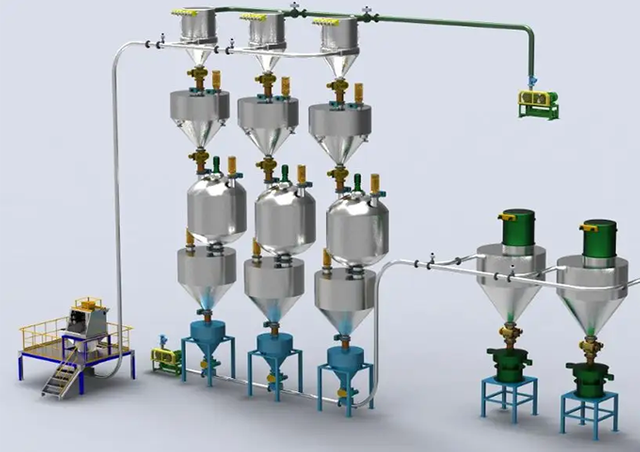
Dense phase systems operate on the principle of low velocity and high pressure. These systems typically utilize compressed air operating above 15 psig, often reaching up to 100 psig depending on the line resistance. Instead of using massive volumes of air to blow material through a line, dense phase uses small volumes of high-pressure air to push material. When you drop material into a pressure vessel, the inlet valve closes and seals. Compressed air enters the vessel, pushing the material into the convey line. The material moves slowly in a dense, pulsating plug or a continuous dune flow along the bottom of the pipe. This extrusion-like flow keeps particles packed closely together, minimizing their movement relative to one another and to the pipe wall.
Contrasting dense phase with dilute phase highlights the mechanical differences. Dilute phase relies on high-speed, suspension-based mechanics. It uses high air volumes at low pressures to keep particles fully suspended in the airstream. This requires velocities often exceeding 4,000 feet per minute. Dense phase utilizes non-suspension mechanics, keeping velocities incredibly low, sometimes under 500 feet per minute. The air-to-material ratio in dilute phase is high, meaning a lot of air moves a little material. Dense phase features a very low air-to-material ratio, moving massive amounts of bulk solid with minimal air.
System Mechanics Comparison
Parameter | Dense Phase Conveying | Dilute Phase Conveying |
|---|---|---|
Velocity | Low (500 - 1,500 ft/min) | High (3,000 - 6,000+ ft/min) |
Operating Pressure | High (>15 psig up to 100 psig) | Low (<15 psig) |
Material Flow State | Plug flow or dune flow (non-suspension) | Fully suspended in airstream |
Air-to-Material Ratio | Low (High material density) | High (Low material density) |
Air Source | High-pressure air compressor | Positive displacement (PD) blower |
Evaluating dense phase conveying applications requires matching specific material behaviors with the physics of low-velocity transport. Certain materials inherently fail in high-speed environments, making dense phase the only viable engineering choice for long-term reliability.
Low velocity exponentially reduces the friction and impact forces on pipes and elbows. Wear in a pneumatic pipeline is proportional to the cube of the particle velocity. If you double the speed of an abrasive particle, you increase the wear rate by a factor of eight. Dense phase systems move materials slowly, drastically cutting down this kinetic energy. Materials like silica sand, fly ash, glass cullet, and alumina quickly destroy standard rotary valves and blow out the backs of elbows in dilute phase systems. Dense phase keeps the abrasive particles packed together, causing them to slide gently along the pipe rather than sandblasting the interior walls. Power plants handling fly ash rely almost exclusively on dense phase to prevent weekly pipe replacements.
Material Hardness and Conveying Suitability
Material | Mohs Hardness | Recommended Phase | Reasoning |
|---|---|---|---|
Silica Sand | 7 | Dense Phase | High abrasion destroys rotary valves and elbows rapidly at high speeds. |
Alumina | 9 | Dense Phase | Extreme hardness requires minimum velocity to prevent pipe blowout. |
Wheat Flour | < 2 | Dilute Phase | Soft, non-abrasive, easily suspended in low-pressure airstreams. |
Glass Cullet | 5.5 | Dense Phase | Sharp edges cause severe cutting wear inside conveying lines. |
Preventing particle degradation is paramount for fragile materials. High-velocity impacts shatter delicate products against pipe walls and elbows. This breakage generates unacceptable levels of dust and fines, ruining product quality. Dense phase mechanics prevent this degradation by keeping particles nestled together in a plug. Because the particles do not bounce around in the airstream, they do not break. This low-speed handling preserves the integrity of materials like roasted coffee beans, extruded pet food, delicate pharmaceutical powders, and specialty plastic pellets. Coffee roasters, for example, spend massive effort perfecting a roast profile. Blowing those beans at 4,000 feet per minute shatters them, altering the brew extraction. Dense phase gently pushes the beans, keeping them entirely intact.
Plug-flow prevents the segregation of mixed batches during transit. When you mix materials of varying bulk densities and particle sizes, maintaining that exact ratio is critical. In a high-speed suspension system, heavier particles fall out of the airstream faster than lighter particles when the air goes around a corner or slows down. This destroys the blend accuracy. Dense phase moves the entire blended batch as a single, solid unit. The material cannot separate because there is no space between the particles for them to sift or settle. What enters the conveying line is exactly what exits the conveying line, ensuring batch consistency for food and chemical processors.
Dense phase physics prove superior for moving heavy loads over long distances, often exceeding 300 feet. Moving massive capacities through a dilute phase system requires massive, highly inefficient blowers and enormous pipe diameters to maintain suspension velocities. Dense phase utilizes high pressure to push heavy loads through smaller pipes with much less air. However, extreme distances present significant friction limitations. Pushing a solid plug of material through hundreds of feet of pipe creates immense resistance. Engineers implement specific interventions, like air boosters injected along the pipeline, to overcome this friction and maintain steady movement over extreme distances.
Selecting the right pneumatic system requires rigorous analysis of your specific operating environment. You must evaluate material characteristics, facility architecture, and available utilities to engineer a functional system. Guessing on any of these parameters leads to plugged lines and failed installations.
System sizing relies heavily on four basic material details. You cannot design a dense phase system without knowing exactly how the bulk solid behaves under pressure.
Bulk Density: This dictates the size of the pressure vessel required to meet your batch or continuous throughput rates. A light material requires a massive vessel to hit high tonnage.
Particle Size Distribution: The range of particle sizes impacts how air moves through the material plug. Uniform particles behave differently than a mix of large chunks and fine dust.
Permeability and Fluidization Potential: This measures how easily air passes through the bulk solid. Highly permeable materials allow air to blow right through them, making plug formation difficult without specialized controls.
Cohesiveness and Moisture Content: Sticky or wet materials bridge inside hoppers and plug conveying lines. High moisture alters how the material responds to compressed air, often turning powders into solid blocks.
Facility architecture directly impacts system choice and pressure drop calculations. Every directional change adds resistance. Vertical lifts require significantly more energy to push heavy material plugs upward against gravity. The number of elbows in the routing path drastically increases the total equivalent length of the pipe, increasing the required operating pressure. Long horizontal runs add continuous friction. You must map the exact routing path to calculate the precise pressure required to move the material from the pickup point to the destination. Using long-radius elbows or specialized blind tees helps manage the wear and pressure drop at directional changes.
Dense phase systems demand reliable, high-pressure compressed air. You must analyze the requirements for plant air versus installing dedicated air compressors. The system requires clean, dry air. Introducing moisture from a compressor into the conveying line causes powders to cake, bridge, or fail to fluidize properly. Oil contamination from compressors ruins food-grade or pharmaceutical products. You must calculate the exact standard cubic feet per minute (SCFM) required and ensure your utility infrastructure can support the intermittent, high-pressure demands of the pressure vessels. Often, facilities install dedicated receiver tanks near the transporters to handle the sudden surge in air demand during the conveying cycle.
You must differentiate between the two primary system types based on your application needs.
Positive Pressure Systems: These utilize compressed air to push material from a pressure vessel to the destination. They are ideal for long distances, high capacities, and highly fragile materials.
Vacuum Dense Phase: These systems use vacuum pumps to pull material from a source to a receiving vessel. They are well-suited for shorter distances, multiple pickup points feeding a single destination, and moving semi-abrasive or easily fluidized materials.
Primary Limitation: Vacuum dense phase is generally not a good choice for conveying highly fragile materials. The material accelerates as it moves toward the vacuum source. The terminal velocity required at the vacuum receiver causes the material to impact the vessel walls, leading to unacceptable product breakdown.
Evaluating pneumatic systems requires looking beyond the initial equipment purchase. You must analyze the long-term operational impact of maintenance, energy usage, and facility modifications to understand the true engineering value.
A transparent breakdown of cost structures reveals distinct differences between conveying methods. Dense phase systems carry higher upfront Capital Expenditure (CapEx). They require heavy-duty pressure vessels built to ASME codes, specialized high-cycle valves, and complex logic controls. However, the Operational Expenditure (OpEx) is often significantly lower. Dilute phase systems handling abrasives require constant replacement of rotary valves, elbows, and blowers. Dense phase systems drastically reduce replacement parts, maintenance labor, and costly facility downtime. The long-term savings in maintenance hours and replacement parts justify the higher initial investment when handling difficult materials.
Energy trade-offs require careful calculation. Dense phase uses significantly less air volume than dilute phase. However, generating high-pressure compressed air requires substantial electrical energy. You must calculate the high-pressure compressed air requirements into the facility's overall energy footprint. Compare the horsepower required for a dedicated air compressor against the horsepower of a large positive displacement blower running continuously. While dense phase uses less air, generating 100 psig air takes more energy per cubic foot than generating 10 psig air.
Physical space requirements often dictate system feasibility. Dense phase transporters require significant vertical headroom. You must fit a large pressure vessel, a heavy-duty inlet valve, and venting equipment directly under your silos or feed hoppers. Standard rotary valves used in dilute phase are highly compact and fit into tight spaces. If your facility lacks vertical clearance, you may face structural modifications to accommodate the necessary pressure vessels, or you might need to dig a pit to house the equipment.
Deploying high-pressure material handling systems introduces specific operational risks. Identifying these failure points during the engineering phase prevents catastrophic system failures after installation.
The primary operational risk in dense phase is material stalling in the line. When you push system limits on distance or throughput, the friction between the material plug and the pipe wall can exceed the available air pressure. The plug stops moving, creating a solid blockage that shuts down production and requires intense manual labor to clear.
Mitigation: Specify the use of air injection systems or air boosters along the convey line. Boosters inject localized bursts of compressed air directly into the pipeline. This overcomes the limitations of long-distance friction and maintains plug movement. Boosters allow the system to restart even if an emergency shutdown occurs while the line is completely full of material.
Relying solely on textbook bulk density figures leads to system failure. Materials behave unpredictably under high pressure. A powder that flows easily in a bucket might pack into a solid, unmovable brick when subjected to 60 psig of air pressure.
Mitigation: Mandate full-scale pilot testing. You must test the exact material under simulated distance and routing conditions at the equipment manufacturer's facility. Empirical testing reveals how the material fluidizes, how it packs, and exactly how much pressure is required to move it reliably.
Standard valves fail rapidly in high-pressure, abrasive environments. Rotary airlock valves leak air under high pressure and their tight tolerances get destroyed by abrasive particles. Butterfly valves wear out quickly when closing through a column of bulk solids.
Mitigation: Specify heavy-duty, inflatable seal dome valves or specialized abrasive-resistant components designed specifically for dense phase cycling. Dome valves utilize a spherical dome that rotates into place, followed by an inflatable seal that expands to create a completely pressure-tight barrier. The seal deflates before the dome moves, entirely preventing abrasive wear between the components.
Dense phase conveying handles the materials that destroy standard pneumatic systems. It provides a specialized mechanical approach when material integrity, severe system wear, or long routing distances dictate low-velocity handling. Forcing standard high-speed systems to handle difficult materials guarantees excessive maintenance and ruined products.Bringing decades of engineering precision and innovation to bulk material handling, Jstark delivers world-class pneumatic systems engineered to tackle your toughest conveying challenges and optimize facility productivity.
Take these specific actions to validate your application and move forward with system design:
Collect representative material samples directly from your active process line for vendor pilot testing.
Map your exact facility routing, documenting every vertical lift and counting all directional changes to calculate accurate pressure drops.
Audit your plant's compressed air infrastructure to verify you have the required SCFM and pressure available for a new system.
Partner with an experienced equipment manufacturer to run full-scale empirical tests validating plug flow behavior for your specific bulk solid.
A: Dense phase uses high pressure and low air volume to push material slowly in a solid plug or dune. Dilute phase uses low pressure and high air volume to suspend material, moving it at high velocities. Dense phase operates with a low air-to-material ratio, while dilute phase relies on a high air-to-material ratio to maintain particle suspension.
A: Dense phase excels with highly abrasive materials like silica sand and fly ash because low velocity reduces pipe wear. It is ideal for fragile products like coffee beans to prevent breakage. It also handles precise blends flawlessly, as plug-flow prevents the segregation of mixed batches during transit.
A: Air boosters inject localized compressed air along the pipeline to overcome severe friction in long-distance routing. They prevent material blockages by maintaining plug movement and allow operators to successfully restart the system even if the line shuts down while completely full of heavy material.
A: Yes, but with strict limitations. Highly cohesive materials tend to pack and bridge under pressure, causing severe line plugs. Handling sticky materials requires specialized fluidization techniques, precise air booster configurations, and mandatory pilot testing to ensure the material will release and flow reliably.
A: Vacuum dense phase is typically limited to shorter distances and handles semi-abrasive or easily fluidized powders. It is explicitly not recommended for highly fragile materials because the terminal velocity required to pull material into the vacuum receiver causes severe impact and unacceptable product breakdown.
A: Increased distance exponentially increases line friction and pressure drop. To maintain flow over long distances, engineers must implement stepped line sizes, expanding pipe diameters to manage air expansion, and install air boosters to overcome the massive resistance of pushing heavy material plugs.
A: Generally, no. Generating high-pressure compressed air for dense phase requires significant electrical energy, often exceeding the motor requirements of drag chains or bucket elevators. However, dense phase offers superior dust containment, routing flexibility, and drastically lower mechanical maintenance compared to mechanical conveyors.